Dartboard Design: A Playful, Punchy Embroidery Asset
As a designer who’s stitched hundreds of machine embroidery designs for client apparel, boutique merchandise, and Etsy sellers, I approach every new embroidery file with two questions: “Will it hold up in real fabric?” and “Will my customer love what they see—not just the idea, but the actual stitched result?” When I opened Dartboard Design, I wasn’t looking for novelty. I was looking for reliability wrapped in charm. And honestly? It delivers—just not where you might first assume.
First Impressions: Bold, Balanced, and Unmistakably Playful
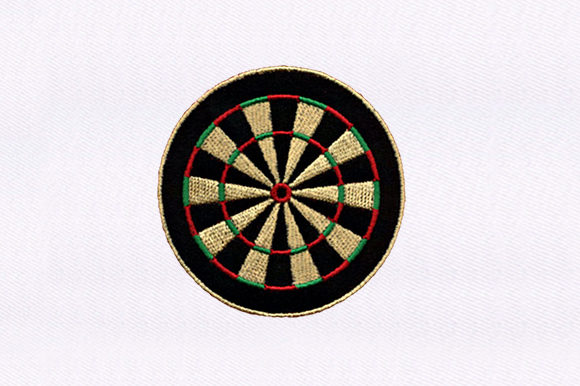
The moment you preview Dartboard Design on screen, its personality clicks: circular symmetry, concentric rings, clean segmentation, and subtle visual rhythm. It’s not cartoonish or cutesy—it’s confident, sporty, and quietly clever. The layout suggests strong stitch planning: no awkwardly stretched elements, no fragile thin lines begging to vanish in fill stitch. This isn’t an applique design; it’s built for precision satin and fill stitch execution. That makes it ideal for projects where clarity matters—like embroidered patches, tote bag centerpieces, or sweatshirt chest logos for game-night themed apparel.
Real-World Use: Where Dartboard Design Shines (and Where It Needs Care)
Last week, I prepped a batch of custom cotton canvas tote bags for a local board game café. Their request? Something fun but not childish—recognizable, scalable, and durable across 50+ washes. Dartboard Design landed perfectly as the front-center motif. At 4.2" wide, it filled the hoop comfortably, stitched cleanly on medium-weight canvas with tear-away + light cutaway stabilizer, and held crisp contrast using navy thread on natural beige fabric.
It also worked beautifully on a relaxed-fit unisex sweatshirt—no puckering, no thread breakage, even across the shoulder seam transition. But here’s where judgment matters: I skipped using it on baby onesies. Why? Not because it’s unsafe, but because the fine inner ring detail (especially at smaller scales) risks softening into a blur on lightweight, stretchy knit. Likewise, curved surfaces like structured caps demand careful digitizing—and since the product description doesn’t confirm cap-specific optimization, I’d test that separately before committing to a bulk order.
For holiday embroidery or personalized gifts—think monogrammed tea towels or linen pillow covers—Dartboard Design adds instant thematic wit without leaning on clichés. It reads as clever, not kitschy. That nuance builds trust: customers recognize effort, not just automation. And for small shop owners curating cohesive collections, this design slots neatly into a “game night,” “pub culture,” or “modern nursery” line—especially when paired with coordinating fonts or minimalist icons in your printable mockups.
Fabric & Function: Know Your Limits
Dartboard Design performs best on stable, medium-to-heavy fabrics: canvas, twill, denim, terry cloth, and midweight quilting cotton. On dark fabric? It gains presence—but check thread color contrast in your embroidery file preview. A light gray fill may disappear on charcoal unless you boost density or switch to off-white thread. On textured fabrics like bouclé or heavy terry, reduce stitch density slightly to avoid “stitch stacking” in the rings. And never skip stabilizer: the concentric geometry relies on consistent tension, and flimsy backing invites distortion.
Avoid cramming it into tiny hoops (<3") without verifying the smallest included size. The design includes multiple formats—10O, ART, CND, DSB, DST, DSZ, EXP, HUS, JEF, PCS, PEC, PES, TAP, VIP, VP3, XXX—so cross-check your machine’s native format and confirm the smallest version maintains legibility. Also note: no lettering means no font compatibility headaches—but it also means branding depends entirely on placement, thread choice, and supporting elements you add.
Design Integrity Meets Commercial Reality
For Etsy sellers and craft business owners, Dartboard Design is more than decoration—it’s a value amplifier. A plain tote becomes a conversation starter. A generic apron gains personality. A holiday gift feels thoughtfully curated, not mass-produced. That perceived craftsmanship directly lifts buyer engagement and repeat interest. But remember: your finished product reflects *your* standards—not just the embroidery file’s quality. So always:
- Test the design on scrap fabric matching your final project’s weight and stretch
- Review stitch density—dense fills hold shape but add stiffness; looser fills breathe better on apparel
- Inspect corners and inner rings at actual stitch-out size (not just screen zoom)
- Compare black-and-white mockups to anticipate contrast on light vs. dark backgrounds
- Confirm licensing terms before selling finished items or bundling the digital embroidery file
This isn’t a “set and forget” design. It rewards attention. When you choose contrasting thread colors intentionally—say, cherry red rings against deep forest green fabric—you’re not just stitching. You’re editing. You’re branding. You’re making something feel handmade, not downloaded.
Final Thought: A Design That Earns Its Place
Dartboard Design won’t replace your go-to florals or script monograms—but it fills a specific, valuable gap: playful sophistication with structural integrity. It belongs on products where wit meets wearability: game-themed merch, bar-crawl swag, teacher appreciation gifts, or even modern nursery decor (paired with neutral linens and wood accents). As a machine embroidery design, it respects the craft. As a commercial embroidery asset, it respects your time and reputation. And as a handmade product foundation? It gives customers something they’ll pause to recognize—and smile about.
If you're evaluating Dartboard Design for your next craft business launch, Etsy listing, or custom apparel run—start small, test thoughtfully, and lean into its clean confidence. It’s not flashy. It’s focused. And in embroidery, focus is what turns a good idea into a great finished product.